
Home // Heat Treatment
Controlled heat defines the outcome of hardening, tempering, and blue annealing. Our induction technology gives strips, bars, rods, and tubes the stable thermal cycles needed for repeatable strength, surface quality, and high-speed heat-treatment lines.
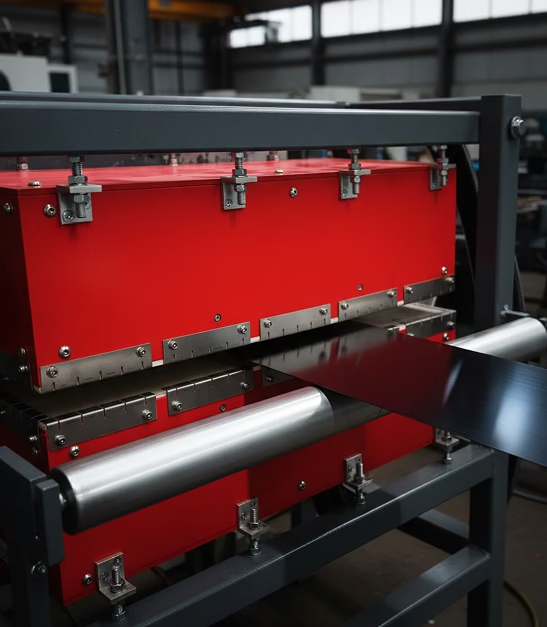
Heat treatment matters wherever material strength, surface finish, and repeatability shape performance. Our induction systems support continuous steel lines, automotive producers working with high-strength sheet, and manufacturers of heavy vehicles and construction machinery that rely on hardened and tempered components. They also fit tube and rod mills where stable tempering drives quality and specialty-steel operations where blue annealing defines surface appearance. If your line needs tighter control, cleaner electric heat, or faster thermal response, this is where induction delivers a measurable upgrade.
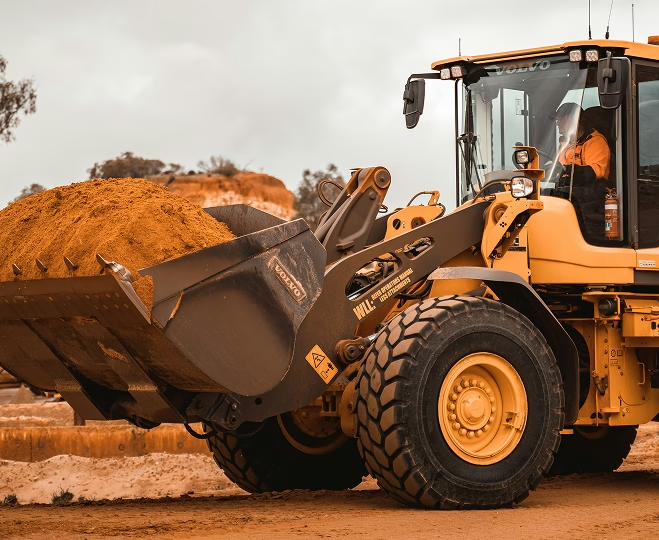
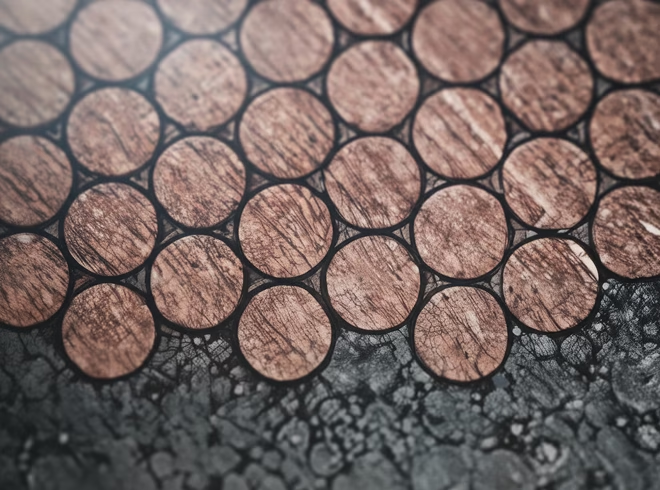
Our unique SM2C flux conductor keeps energy inside the workpiece instead of bleeding into the coil or machine. That means faster reaction, steadier surfaces, and fewer temperature swings in hardening, tempering, and blue annealing. Our modular boosters add heating capacity beside existing tunnel furnaces, lifting throughput without rebuilding the line – and the cleaner, electric process reduces cooling demand and operating costs.
Hardening, tempering and blue annealing depend on thermal cycles that hold a defined temperature window. If heat drifts, material strength, microstructure and surface behaviour shift with it. Induction provides controlled, repeatable heat directly at the surface, supporting the consistent temperature curves required for predictable mechanical performance and reliable downstream forming.
Furnaces deliver deep, slow heat that reacts poorly to speed changes. Induction heats the workpiece through a controlled magnetic field, not the surrounding environment. MagComp’s magnetic-circuit innovation keeps power focused on the material, maintaining tight thermal stability while reducing energy loss. This supports faster cycles and surface-correct results at high line speeds.
Yes. Heat treatment is especially sensitive to speed fluctuations, and induction responds immediately to them. Soft-switching power control keeps output steady, while our mouldable magnetic material shapes a stable magnetic circuit. This ensures the heating zone remains accurate even as throughput accelerates or slows, protecting the material’s final hardness and surface quality.
Induction can work seamlessly as a booster beside existing tunnel furnaces. It raises the material to the correct temperature before furnace entry or restores heat after temperature losses. This increases furnace capacity without rebuilding the line. Boosters also enable compact hybrid solutions, improving throughput with minimal footprint and lower energy use.
Blue annealing relies on precise surface heating to achieve consistent colour and microstructural behaviour. Induction directs energy into the workpiece surface with controlled magnetic flux, avoiding thermal overshoot that can distort appearance. Field focus and reduced stray energy help maintain uniform temperature, supporting the process’s strict surface requirements.
Every heater is engineered around the customer’s exact process requrements. We simulate electromagnetic and thermal response using your profile geometry, alloy type and target cycle. Coil design and our composite magnetic material are then adapted to shape the field for that profile. Modular heater blocks scale to the footprint, ensuring each strip, bar, rod or tube reaches the correct temperature window with verified precision and repeatability.
"*" indicates required fields